


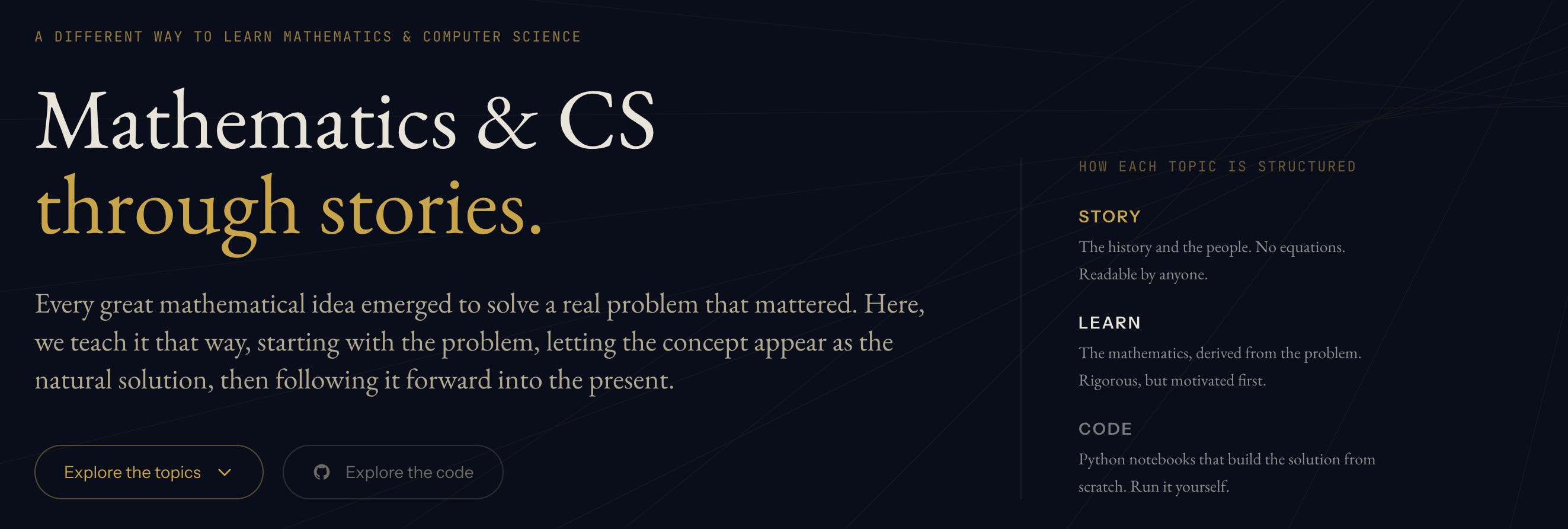
I’ve been thinking about this for a long time.
Not building it, thinking about it. The itch goes back to high school and IIT Delhi, where I spent many years being handed definitions, theorems, and proofs in that order. Memorize the abstraction. Apply it to a contrived example. Pass the exam. Move on.
And I did move on. Into a career built almost entirely on applied mathematics: optimization, probability, information theory, machine learning. The very things I was taught as inert academic objects turned out to be the most powerful tools I’d ever use.
But here’s what bothered me: I didn’t really understand them until I needed them. Until there was a problem in front of me that demanded a solution and the math showed up as the only natural answer.
That’s backwards from how we teach it. And I think it does a lot of damage.
Bayes’ Theorem is a perfect example.
In a textbook, it looks like this: a formula, a definition of conditional probability, a few toy examples about colored balls in urns. It feels like a curiosity.
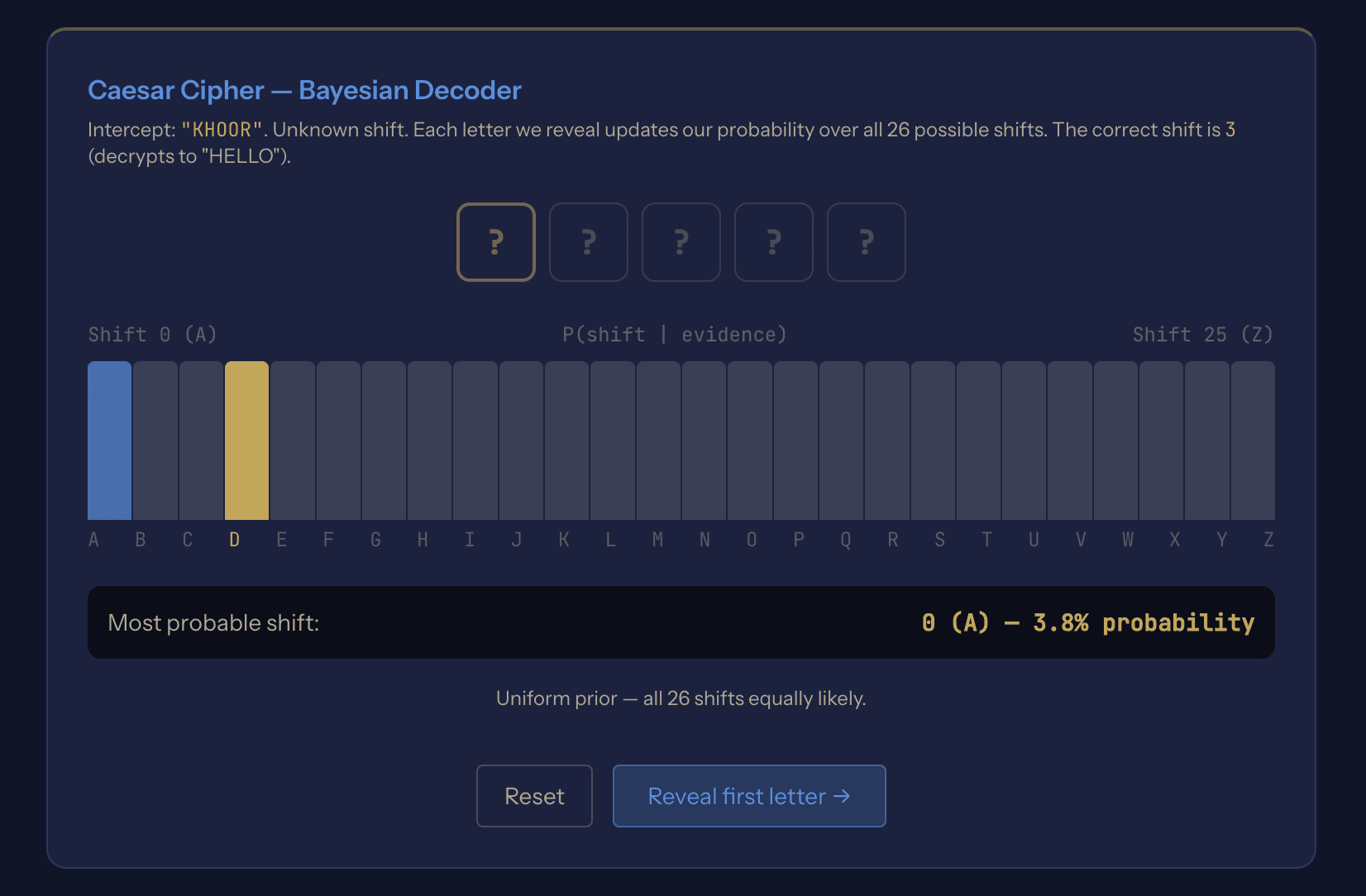
Here’s what it actually is: Alan Turing, Bletchley Park, 1941. The German Navy is sinking Allied convoys faster than they can be replaced. Turing has 10²³ possible Enigma cipher settings and roughly eighteen hours to eliminate all but one of them before the next transmission. Without a systematic way to update his beliefs as each intercept came in, the war at sea is probably lost. Bayes’ Theorem isn’t a formula in that room. It’s the only tool that works.
That context doesn’t make the math easier. It makes it matter. And when math matters, you remember it, not as a thing to be recalled on an exam, but as a tool with a history and a reason for existing.
Same story with Information Theory. Claude Shannon didn’t sit down one day and decide to invent a mathematical definition of information. The U.S. government needed to send Roosevelt’s voice across the Atlantic without the Nazis intercepting it. Shannon had to figure out what “information” actually was before he could figure out how to protect it. The math that followed, entropy, channel capacity, compression, emerged as the natural answer to a question that had genuine stakes.
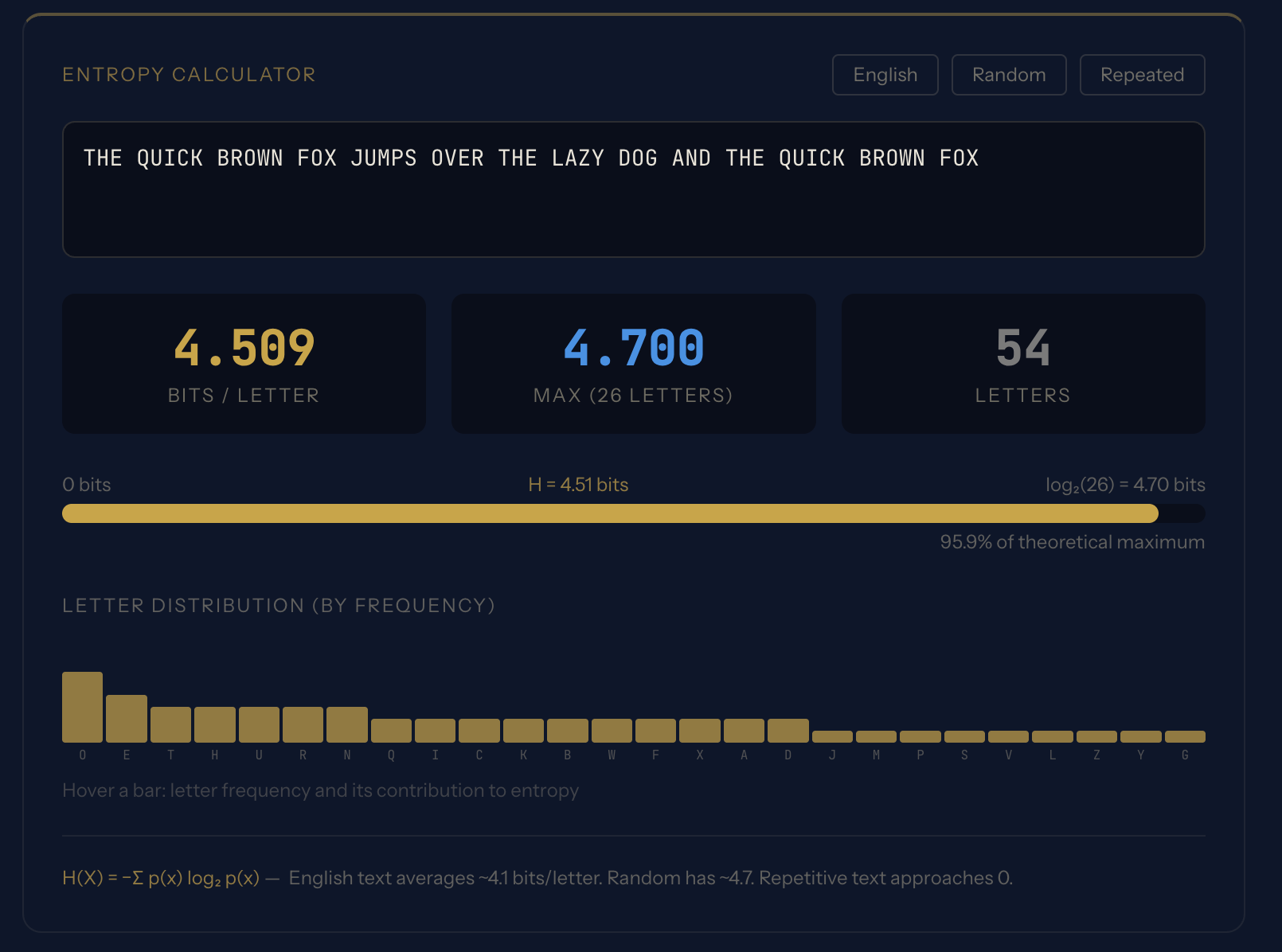
That’s the animating idea behind Lutchet, which I launched this week.
Every topic starts with a real historical problem, one where getting the math wrong had consequences. The concept emerges as the only natural solution to that problem. Then we follow it forward to show where it lives in the world today.
Each topic has three layers: the Story (history and people, no equations, readable by anyone), the Learn (the mathematics, derived from the problem, rigorous but motivated first), and the Code (Python notebooks that build the solution from scratch, run it, break it, make it yours).
The first two topics are live: Bayes’ Theorem through Turing and Enigma, and Information Theory through Shannon and the scrambled telephone line that connected Roosevelt to Churchill. A narrative page connects them, because Turing and Shannon actually met in 1943, and that conversation is one of the great “what were they talking about?” moments in the history of science.
Why “Lutchet”?
A lutchet is a deck fitting that allows a ship’s mast to pivot and pass under a bridge. The mast doesn’t shrink. The ship keeps moving.
That felt right. The goal isn’t to make the math smaller or easier. It’s to give people a way through the thing that’s been blocking them.
If you have a kid learning math or CS, a friend who bounced off calculus or statistics and never went back, or you’re just someone who always suspected the textbook was leaving something out, go take a look.
And if this resonates with you, forward it to someone. The kind of person who learned to code but never quite trusted the math underneath it. The kind of person who aced the exam and still walked away feeling like they’d missed something.
That’s exactly who I built this for.
Lutchet is open source. The code is on GitHub. More topics coming.