


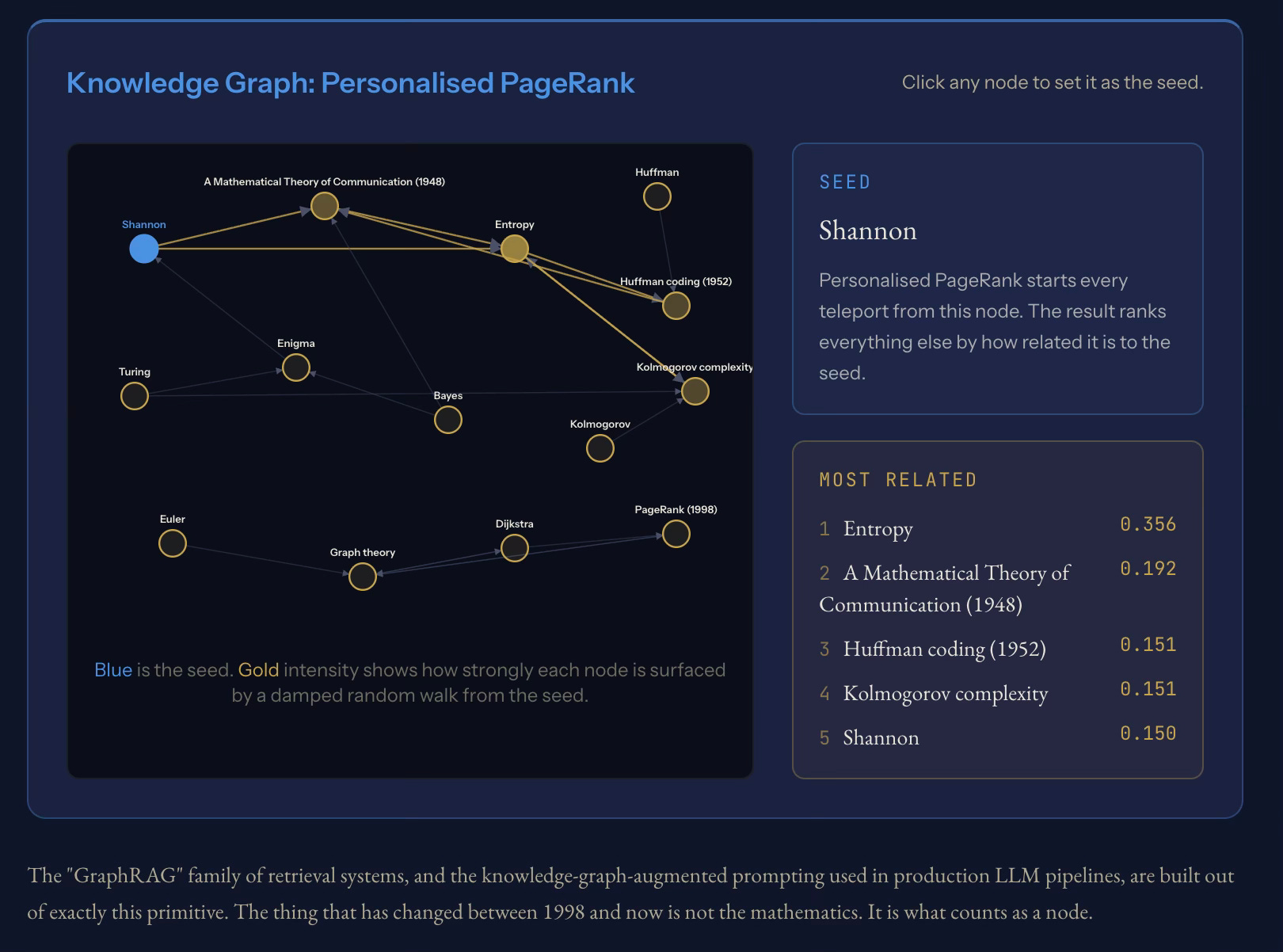
A few weeks ago I introduced Lutchet, a project I’ve been building to teach math and CS the way I wish I’d learned it: problem first, concept second, history as the through-line. We dug into Alan Turing and the Bayes Theorem, and Claude Shannon and Information Theory. For the next installment, I got a tad ambitious and explored Graph Theory. And learnt so much!
Here’s the thing about Graph Theory: it doesn’t look like a big deal when you first encounter it. Nodes. Edges. Paths. It feels like a warmup exercise.
But it’s the invisible architecture of almost everything.
Every packet you send traverses a graph. Every route you drive. Every recommendation you get. And increasingly, every fact a language model retrieves. The whole modern internet, GPS navigation, Google’s original PageRank algorithm, the way LLMs reduce hallucination through knowledge graphs: all of it sits on a mathematical foundation that began as a parlour puzzle in a Prussian city in 1736.
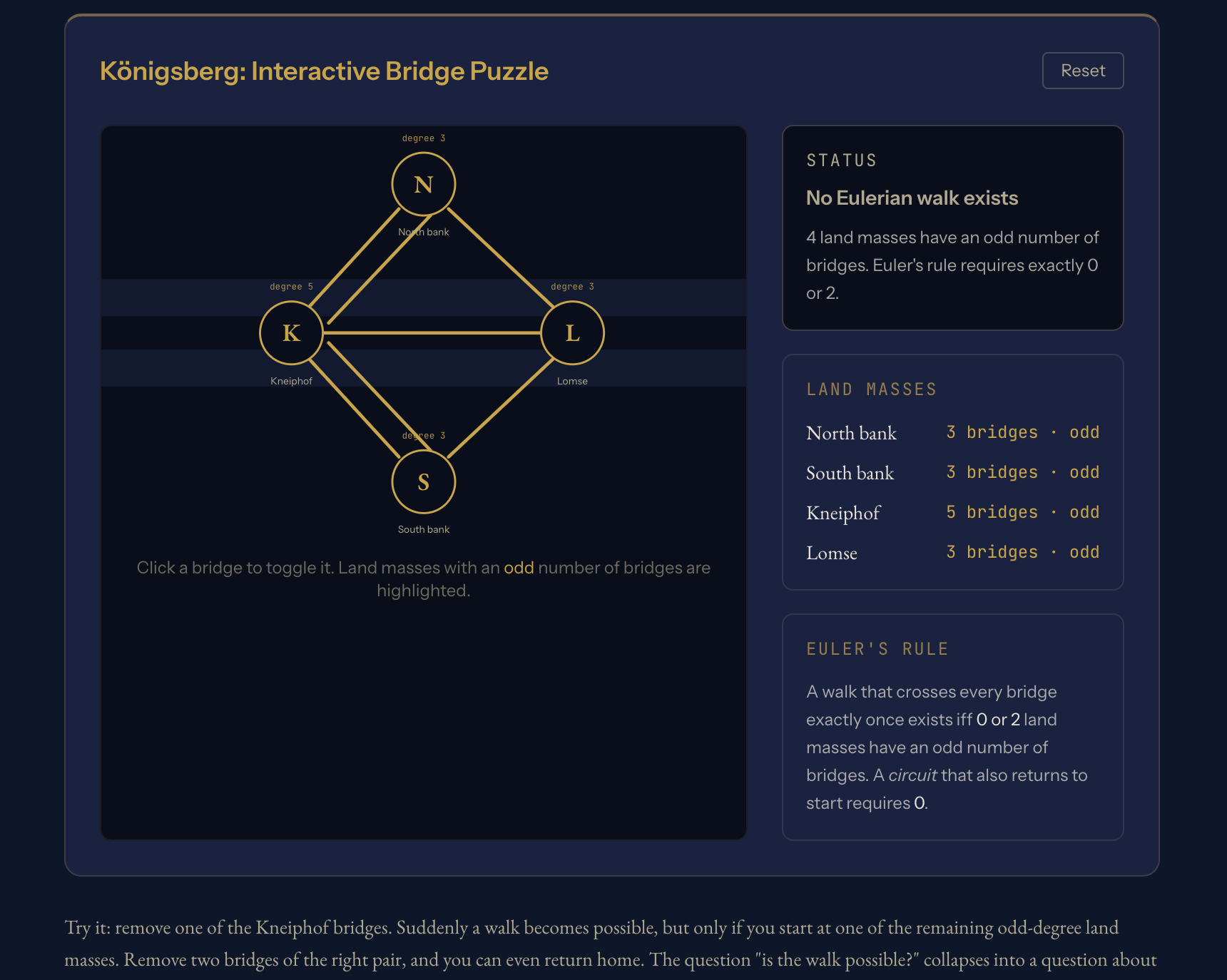
Leonhard Euler was one of the most prolific mathematicians in history. In 1736 he turned his attention to a question the residents of Königsberg had been arguing about for years: could you walk across all seven bridges of the city without crossing any one of them twice?
Euler’s insight was that the answer had nothing to do with the map. It didn’t matter where the bridges were, how long they were, or what they looked like. All that mattered was how the pieces connected. He stripped the problem down to its abstract structure, proved the walk was impossible, and in doing so accidentally invented a new branch of mathematics.
Nobody fully appreciated what he’d done for another two centuries.
That gap is one of the things I find most fascinating about this story. Graph Theory developed quietly, mostly inside academic circles, largely unnoticed. Dénes König wrote the first proper textbook on it in 1936. Eight years later, the Allies were planning the largest amphibious invasion in history at Normandy, facing exactly the kinds of network problems graph theory could have helped solve. The formal tools didn’t exist yet in the right hands. They improvised. They won anyway.
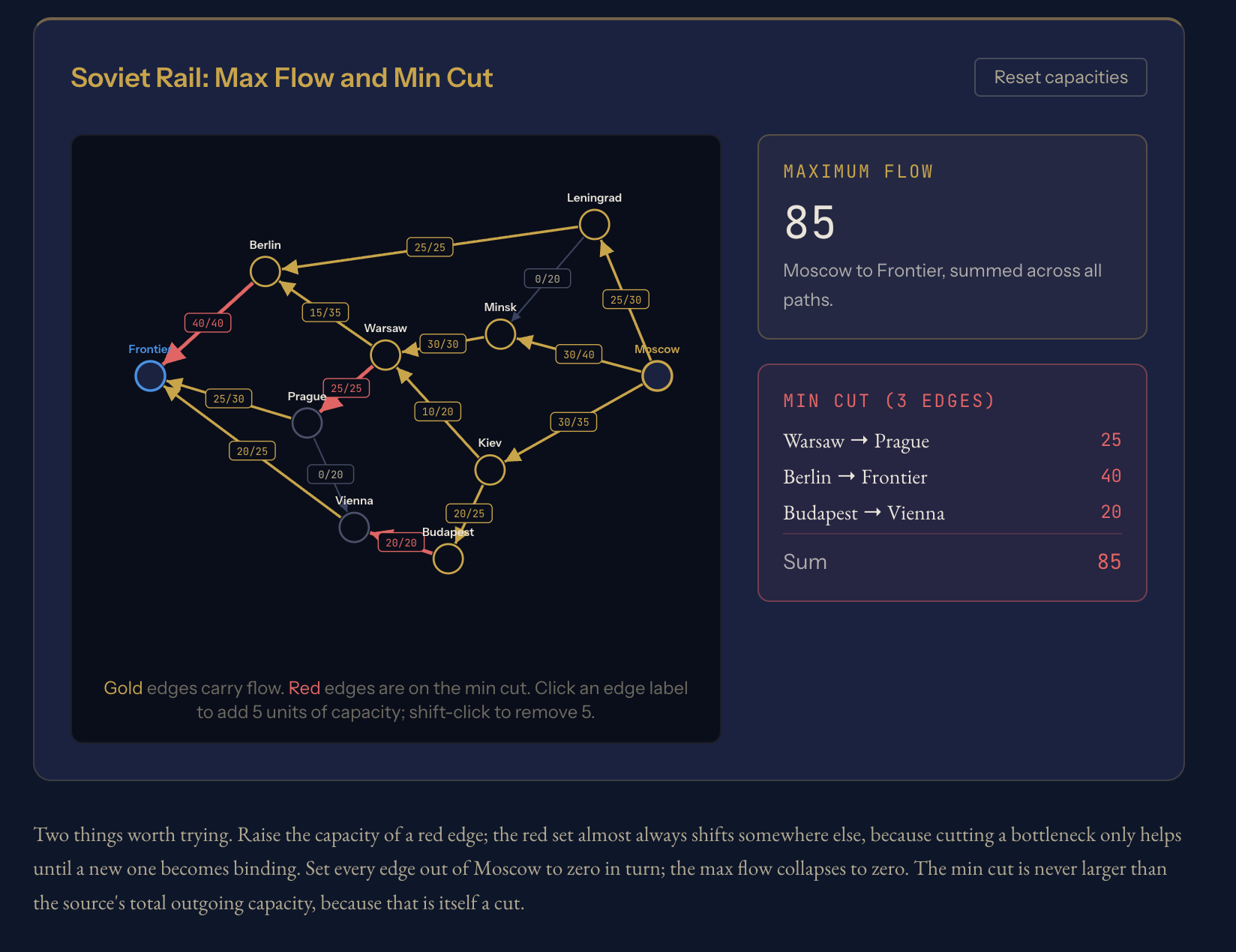
A decade after that, American analysts at RAND were studying the Soviet rail network, trying to figure out which rail lines to sever to cut off supply lines. The mathematical answer, max-flow/min-cut, was being developed one floor away at the same time. The war Normandy ended had created the urgency to finally build the tools Normandy needed.
The Lutchet Graph Theory module tells four stories across three centuries:
Königsberg in 1736, where Euler stops looking at the map and sees only the connections. Amsterdam in 1956, where Edsger Dijkstra sketches an algorithm over coffee, without a pencil, in twenty minutes, and produces the routing logic that still moves packets across the internet today. RAND in 1955, where a classified targeting study and a math problem collide. And Stanford in 1998, where a random walk on the web graph becomes Google, and the same idea turns up again thirty years later as the frontier for making language models less confabulatory.
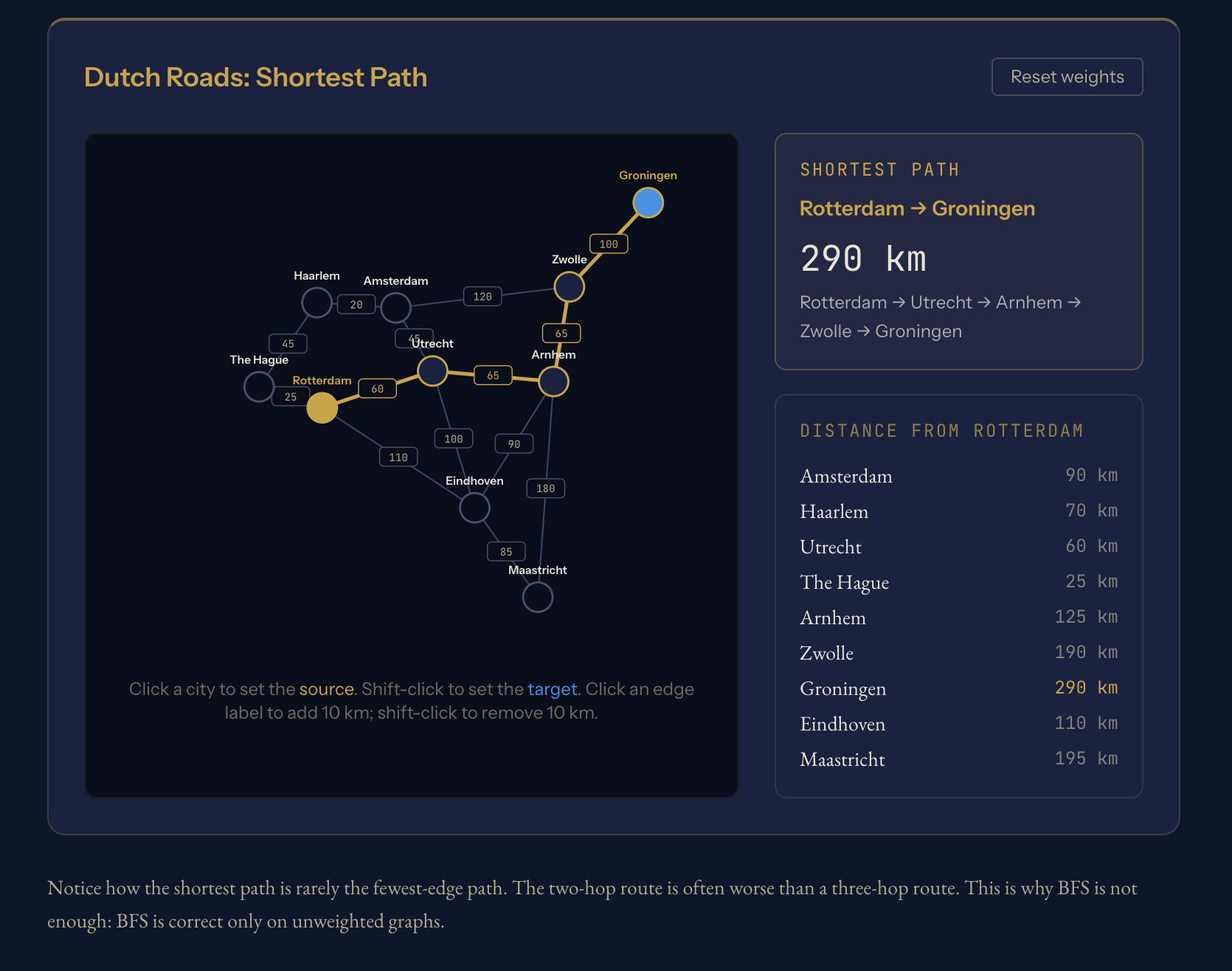
Same idea. Different century. Still running.
Each story has three layers: the narrative (no equations, readable by anyone), the mathematics (rigorous, but earned), and Python notebooks you can run yourself.
If you’ve been meaning to look and haven’t yet, now’s a good time.
And if you know someone who’s curious about how the internet actually works, or why Google was different, or what the Allies were doing the night before D-Day: send this to them. That’s exactly who I built it for.
More topics coming. The code is on GitHub. Feedback always welcome.